Micron Technology, Inc. announced that it is launching an industry’s highest-density, radiation-tolerant single-layer cell (SLC) NAND product. With a die capacity of 256Gb, this product is the first in a portfolio that will include space-qualified NAND, NOR and DRAM solutions. See https://www.storagenewsletter.com/2025/07/28/micron-launches-space-qualified-portfolio-to-power-mission-critical-data-for-aerospace-innovation/ for details.
This sparked the question of why Radiation-tolerant memory is needed and how is it achieved.
Why We Need Radiation-Tolerant Memory
When most people think about technology in space, they imagine rockets, satellites, or the Mars rover. Yet behind every mission-critical system lies something less glamorous but absolutely essential: memory. Specifically, radiation-tolerant memory - the unsung hero ensuring that data survives in the harshest environments humanity has ever explored.
The Harsh Reality of Space
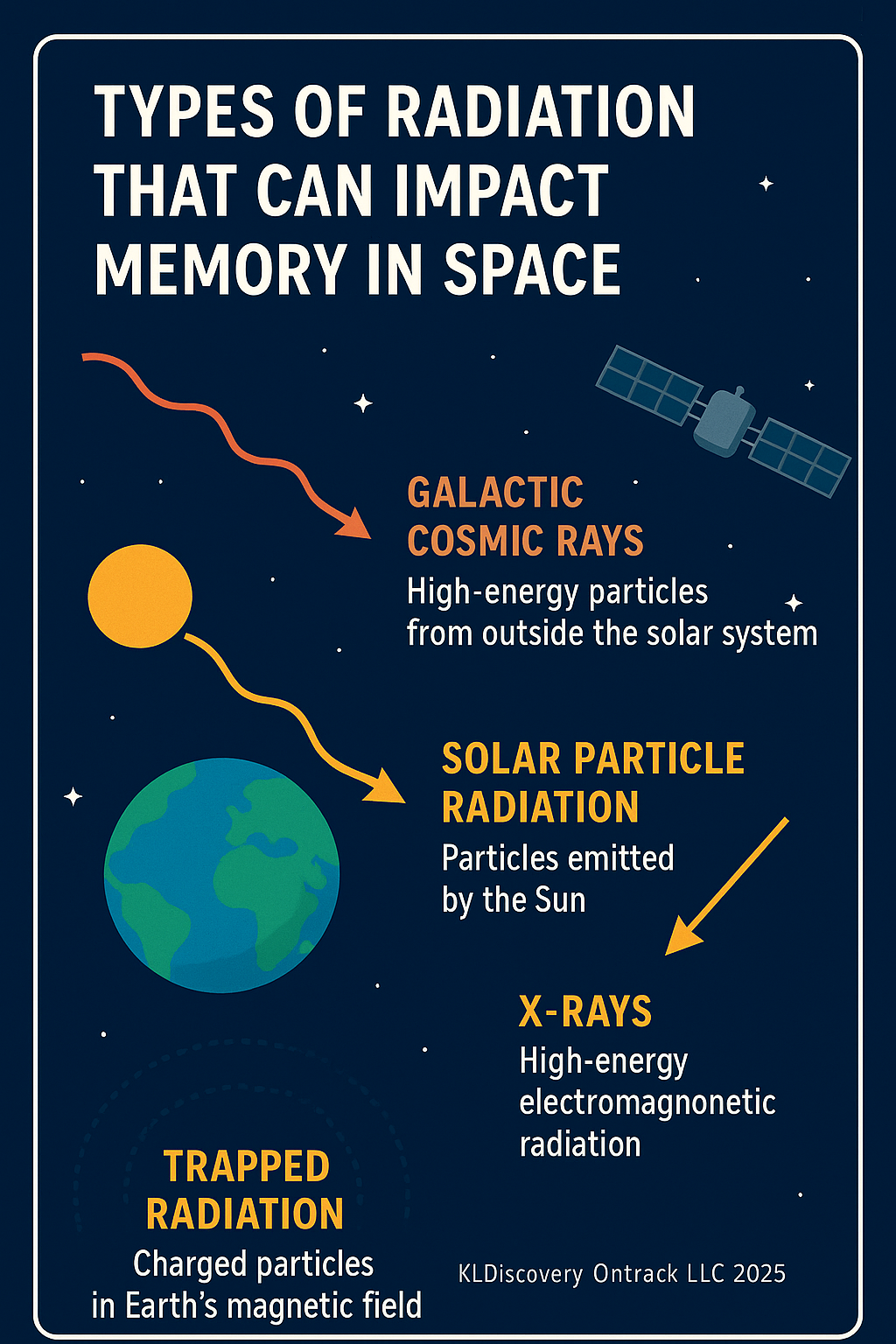
Space is not the friendly void we often see in movies. It’s a battlefield filled with cosmic rays, solar flares, and high-energy particles constantly bombarding spacecraft electronics. On Earth, our atmosphere and magnetic field shield us from most of this radiation. But once you leave our planet, technology is left exposed.
Radiation can wreak havoc on microelectronics. A single charged particle can flip a bit in memory, corrupting instructions or critical data. In worst-case scenarios, this can cause system crashes or mission failures—outcomes that are not just costly but sometimes irreparable.
Why Ordinary Memory Isn’t Enough
Conventional computer memory is designed for Earth-based conditions. It works well in your phone or laptop, but in space, these chips are incredibly vulnerable. Radiation can cause:
- Ionizing Radiation: High-energy particles like cosmic rays, gamma rays, x-rays, and particles from nuclear reactions can disrupt the electronic structure of memory chips.
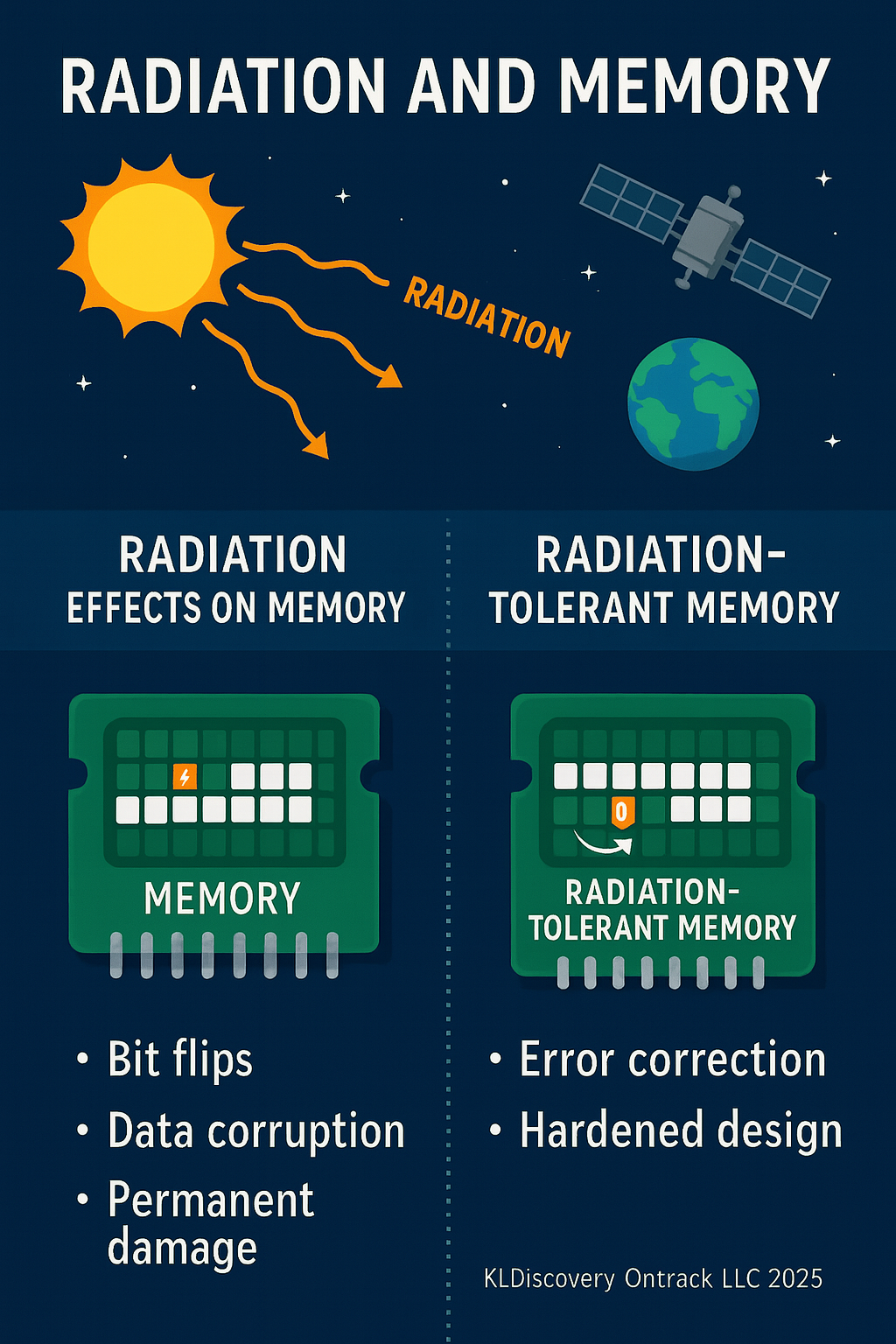
- Single Event Upsets (SEUs): Random bit flips in memory that alter stored information.
- Total Ionizing Dose (TID) Effects: Prolonged exposure to radiation can degrade the performance of electronic components over time.
- Latch-ups: Current surges that can permanently damage circuits.
- Data corruption: Silent errors that go unnoticed until they cause malfunctions.
For a satellite orbiting Earth—or a probe heading to Jupiter—these risks are unacceptable. Without protection, we’d be gambling with billions of dollars in hardware and decades of planning.
How Radiation-Tolerant Memory Makes the Difference
Radiation-tolerant memory is purpose-built to withstand these harsh conditions. It incorporates advanced design strategies such as:
- Shielding: Using materials like lead or tungsten to physically block radiation from reaching sensitive components.
- Error Detection and Correction (EDAC): Automatically identifies and fixes corrupted data.
- Redundant architectures: Ensures that if one memory cell fails, others can compensate.
- Hardened materials and layouts: Reduce the probability of radiation particles disrupting circuits.
- Rigorous testing: Chips are validated through radiation exposure tests to prove reliability.
This technology doesn’t make memory “invincible,” but it drastically reduces the risks of catastrophic failure.
The Stakes Are Higher Than Ever
As humanity pushes deeper into space—toward the Moon, Mars, and beyond—the demand for reliable computing grows exponentially. Future missions will rely on:
- Autonomous navigation: Spacecraft making real-time decisions far from Earth.
- AI-driven analysis: Onboard data processing without waiting for signals from mission control.
- Long-duration missions: Systems must operate flawlessly for years or decades.
In all these cases, radiation-tolerant memory isn’t optional—it’s mission-critical.
Beyond Space: Earth-Based Applications
Interestingly, the benefits don’t end in space. Radiation-tolerant memory also plays a role in:
- Nuclear power plants: Safeguarding control systems against radiation exposure.
- Medical imaging equipment: Ensuring reliability in MRI and radiation therapy machines.
- Military and aviation systems: Maintaining performance in high-altitude or combat environments.
Conclusion
Radiation-tolerant memory may not grab headlines like rockets or space telescopes, but without it, modern space exploration—and many Earth-based technologies—wouldn’t be possible. It is the quiet backbone of mission success, ensuring that when humanity reaches for the stars, our data makes the journey safely with us.
Of course, even the most carefully engineered systems face risks that cannot always be eliminated. When flash-based memory is compromised—whether by radiation exposure in orbit, high-energy particles in medical environments, or unforeseen failures in critical infrastructure—the ability to recover data becomes just as important as protecting it in the first place.
That’s where Ontrack Data Recovery plays a pivotal role. With decades of specialized experience and proprietary methods designed for the unique challenges of flash storage, Ontrack provides organizations with a great chance of retrieving mission-critical information when it matters most. Their proven expertise ensures that, even in the harshest conditions, your data has a path back.

 Australia | English
 Locations
 Search






 Back to listing


